
Earning your PMP certification for working professionals is no longer a pipe dream reserved for people with endless free time. Thousands of full-time employees add “PMP” after their name every year, and most of them never took a single day off work to do it. If you have a demanding job and a real ambition to lead bigger projects, this guide shows you the exact, repeatable path to pass the PMP exam while keeping your day job.
Table of Contents
- What the PMP Certification Actually Is
- Why PMP Certification for Working Professionals Pays Off
- Are You Eligible? The Requirements Explained
- How to Apply to PMI (Step by Step)
- What the PMP Exam Actually Looks Like
- Your 12-Week Part-Time Study Plan
- Sample Weekly Study Calendar
- Study Resources That Actually Work
- Common Challenges (and How to Beat Them)
- Five Mistakes Working Professionals Make
- PMP vs Other Certifications for Working Professionals
- After You Pass: PDUs and Renewal
- Frequently Asked Questions
- Get a Free PMP Consultation
What the PMP Certification Actually Is
The PMP certification for working professionals is the gold-standard credential from the Project Management Institute (PMI). It proves you can lead and direct projects across any industry. Unlike a generic management seminar, it is exam-based, globally recognized, and frequently listed as “required” or “preferred” for senior project roles. For working professionals, the appeal is simple: it is portable, respected, and earned on your own schedule.
PMI built the PMP around real-world practice, not theory alone. The exam tests how you apply people, process, and business-environment principles to situational questions. That is good news for working professionals, because you already live inside real projects every day. The certification simply gives your experience a language and a credential that hiring managers trust.
Why PMP Certification for Working Professionals Pays Off
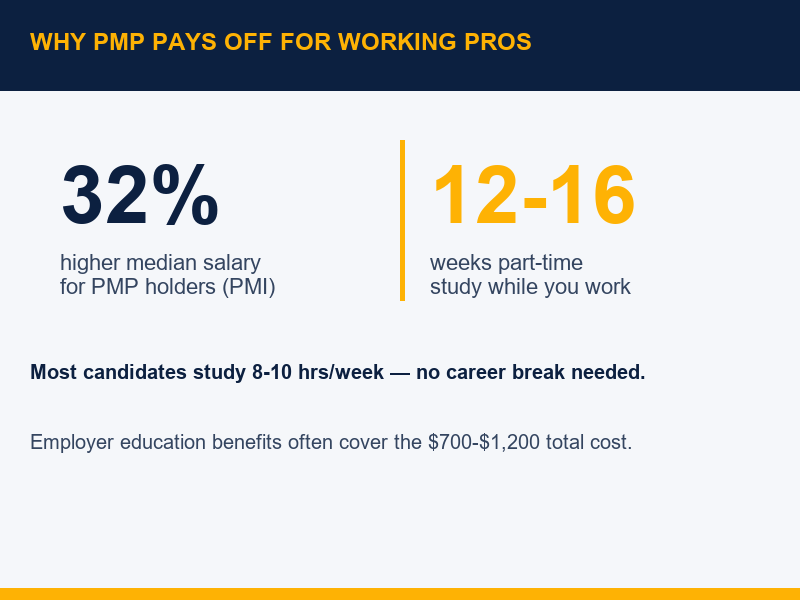
There is a reason PMP keeps topping “most valuable certifications” lists. PMI’s own salary survey shows PMP holders earn a median 32% more than non-certified peers. For working professionals, that premium compounds over a whole career. Beyond money, the credential signals you can be trusted with budgets, stakeholders, and delivery risk.
A second, quieter benefit matters even more to people with a day job: confidence. When your title says “PMP,” managers hand you the messy, high-visibility projects. That visibility is how working professionals move from contributor to leader without changing companies. It also travels. A PMP earned in one country is understood in nearly every other, which matters if your career might cross borders.
Are You Eligible? The Requirements Explained
Before you build a study plan, confirm you can sit the exam. PMI requires project leadership experience plus formal education. The exact mix depends on your background.
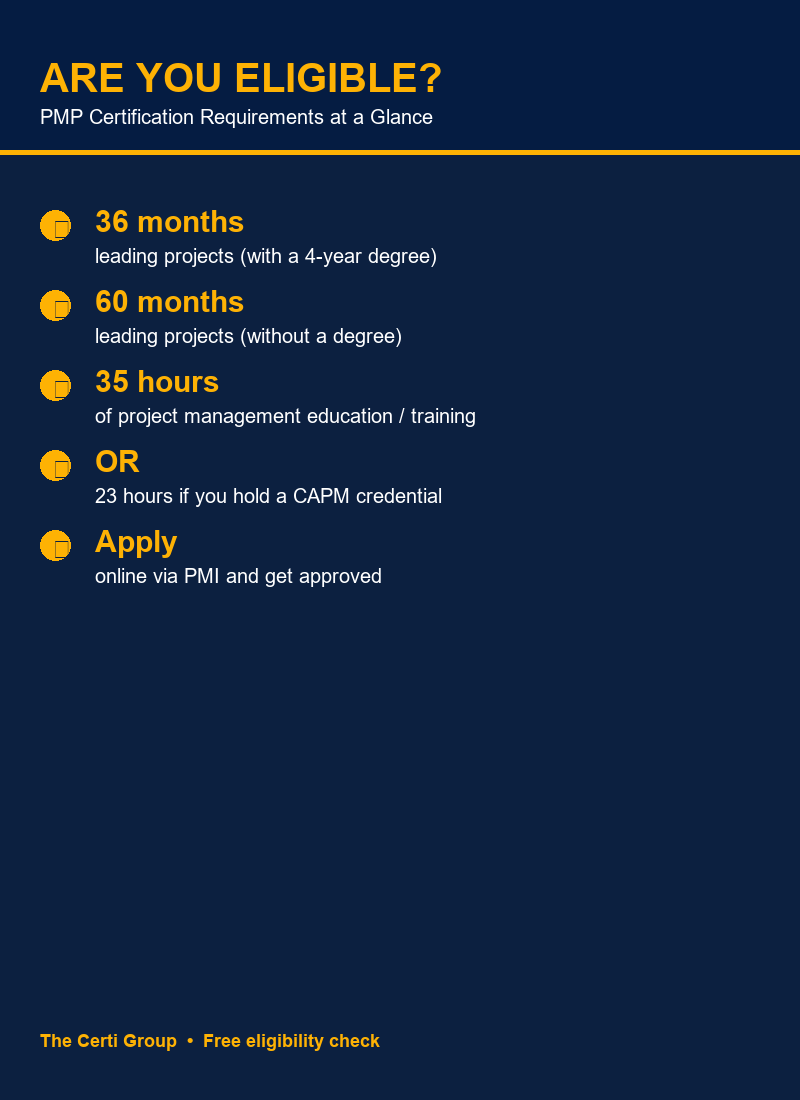
If you hold a four-year degree, you need 36 months of experience leading projects and 35 hours of project management training. Without a degree, the bar is 60 months of leadership experience. Holding a CAPM credential can reduce the training requirement to 23 hours. The key for working professionals is to start logging hours now, while the work is fresh in your memory, because PMI audits a percentage of applications and expects detail.
Not sure where you stand? Our PMP certification support page walks through the application step by step, and our advisors will sanity-check your eligibility for free before you spend a dollar on the exam.
How to Apply to PMI (Step by Step)
The application is where many working professionals stall, so here is the straight version. First, create a free PMI account and start the online application. You will describe your project experience in 500-character chunks, focusing on leadership outcomes rather than task lists. Second, enter your 35 contact hours of education from a registered provider. Third, submit and wait for PMI’s review, which usually takes a few business days. If selected for audit, PMI asks for signed confirmation from a supervisor or client.
Only after approval should you pay and schedule the exam. Working professionals benefit from booking the date before they finish studying, because a fixed deadline is the strongest antidote to “I’ll study next week.” Treat the exam date like a project milestone you cannot quietly move.
What the PMP Exam Actually Looks Like
The current PMP exam is 180 questions over 240 minutes, including two short breaks. Questions are situational, not definitional. Roughly half lean agile or hybrid, and the rest predictive. You will see multiple-choice items plus some matching and hotspot formats. The PMP certification for working professionals feels hard not because the math is complex, but because every option looks plausible. That is why practice under timed conditions matters more than re-reading the guide.
Scoring is pass or fail, based on a difficulty-weighted rubric PMI does not publish in detail. You do not need a perfect paper. Most working professionals who consistently score above 70% on full-length practice exams walk in confident and walk out certified. On exam day itself, arrive early, bring the required ID, and eat normally. A calm, fed candidate outperforms a frazzled genius every time.
Your 12-Week Part-Time Study Plan
The single biggest myth about the PMP certification for working professionals is that you need six months off. You do not. A focused 12-week plan, built around evenings and weekends, is enough for most candidates who already work in projects.
Weeks 1 to 2: learn the framework. Read the core PMI standards and map the three exam domains to your daily work. Weeks 3 to 6: drill concepts with video lessons and flashcards, about 45 minutes on weeknights. Weeks 7 to 9: full-length practice exams under timed conditions, then review every wrong answer. Weeks 10 to 12: plug gaps, simulate exam day exactly, and book the test.
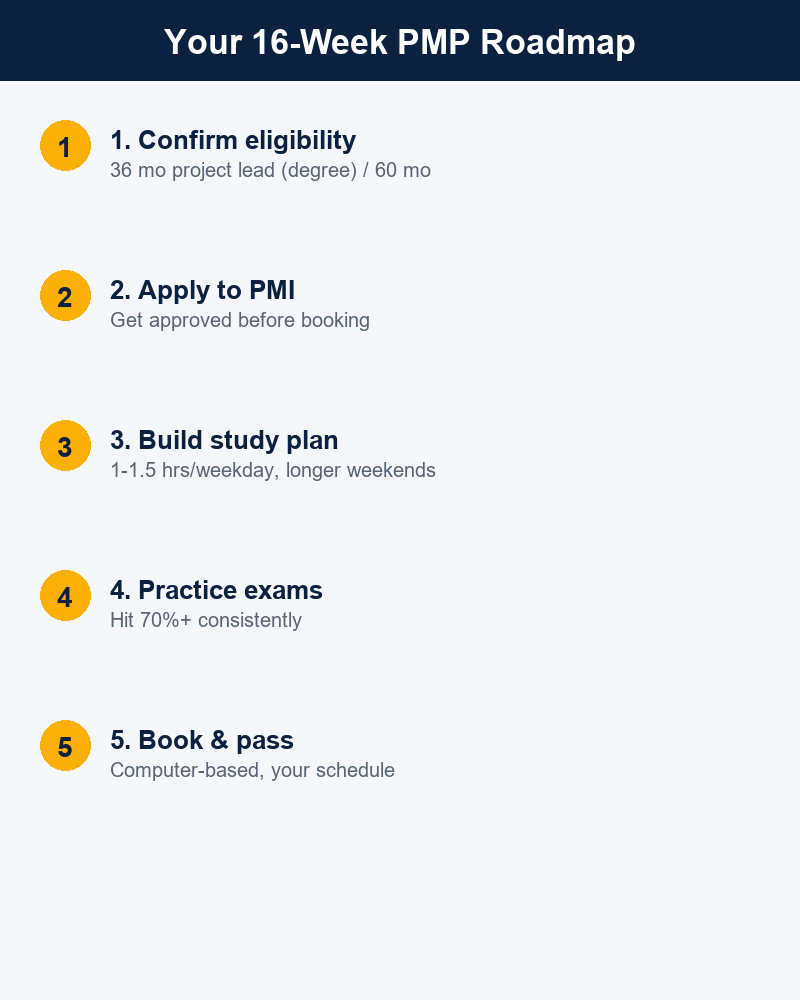
The roadmap above stretches the plan to 16 weeks for candidates who prefer a gentler pace. Either way, the rule for working professionals is consistency over intensity. Forty-five minutes every weekday beats a frantic six-hour cram on Sunday night, because cramming evaporates from memory before exam day.
Sample Weekly Study Calendar
A plan you can see is a plan you keep. Here is a realistic week for someone with a nine-to-six job.
| Day | Focus | Time |
|---|---|---|
| Monday | Watch one domain video lesson | 45 min |
| Tuesday | Flashcards: process groups | 30 min |
| Wednesday | 10 practice questions + review | 45 min |
| Thursday | Agile/hybrid deep dive | 45 min |
| Friday | Review wrong answers from the week | 30 min |
| Saturday | Timed mini-exam (60 questions) | 90 min |
| Sunday | Rest or light reading | optional |
That is roughly 5 to 6 hours a week. Over 12 weeks it compounds into real readiness, and it never asks you to choose between your job and your goal.
Study Resources That Actually Work
You do not need to buy everything. For the PMP certification for working professionals, a lean stack beats a crowded shelf. Start with the official PMI materials, add one reputable video course, and lean hard on practice exams. Practice questions are where working professionals separate a pass from a fail, because they teach you PMI’s wording, not just the theory.
Build a small study group with two or three colleagues. A weekly 30-minute call to debate tricky questions keeps momentum alive when work gets busy. If self-study feels lonely, our certifications hub links to structured prep options designed around a full-time schedule, including formats that fit commutes and lunch breaks.
Common Challenges (and How to Beat Them)
Every working professional hits the same walls. “No time” is the most common. The fix is to schedule study like a meeting and protect it the way you would a client call. “Eligibility confusion” stalls applications; track your project hours in a simple spreadsheet from day one so the form takes minutes, not weekends. “Exam anxiety” drops once you have taken three or four timed full-length exams and seen your score climb above 70%.
Another quiet killer is comparison. Do not measure your pace against someone studying full-time. The PMP certification for working professionals is a marathon at marathon speed. Steady weekly progress is the whole strategy, and it is enough.
Five Mistakes Working Professionals Make
First, they start studying before confirming eligibility and waste weeks if the audit fails. Second, they collect courses instead of finishing one. Third, they skip full-length timed exams and then freeze under real time pressure. Fourth, they memorize ITTOs (inputs, tools, techniques, outputs) by rote instead of understanding flow. Fifth, they book the exam too late, letting work crises push it indefinitely. Avoid these five and your odds rise sharply.
PMP vs Other Certifications for Working Professionals
PMP is broad, but it is not the only move. If you lead agile teams, the PMI-ACP (Agile Certified Practitioner) may fit better. If sustainability and the built environment are your world, the LEED AP (Accredited Professional) or LEED GA (Green Associate) credentials carry real weight. Risk-focused professionals should look at the RMP (Risk Management Professional), and analysts at the PMI-PBA (Professional in Business Analysis).
The smart play for working professionals is to pick one flagship credential, earn it, then stack a complementary one later. PMP first, then a specialty, is the path most employers respect, because it proves both breadth and a deliberate career direction.
After You Pass: PDUs and Renewal
Passing is not the end. Your PMP is valid for three years, and you renew it by earning 60 Professional Development Units (PDUs). The good news for working professionals is that many PDUs come from the work you already do: giving a lunch-and-learn, mentoring a junior, or attending industry webinars. You do not need a second full study cycle; you need to keep learning in public and log it.
Is the PMP Certification for Working Professionals Worth It in Your Role?
The honest answer depends on where you are. If you are an engineer, a coordinator, or a team lead being asked to “own” delivery, the PMP certification for working professionals is one of the highest-leverage moves you can make, because it turns informal responsibility into a credentialed skill. If you are already a director with an MBA and a track record of shipped projects, the marginal boost is smaller, though the credential still helps when you change employers or industries.
For career switchers, PMP is a signal that you speak the universal language of project delivery. Recruiters filter on it. For people staying inside one company, it is often the differentiator between two equally capable internal candidates. Weigh the ~$1,000 cost and three months of evenings against a 32% median salary lift, and for most working professionals the math is comfortably positive.
Study Techniques That Actually Move the Score
Not all study time is equal. The PMP certification for working professionals rewards active recall over passive reading. Use spaced repetition for terminology, but spend the bulk of your hours on practice questions, because the exam rewards judgment, not memory. After every wrong answer, write one sentence on why the correct choice won. That habit alone closes more gaps than any extra video.
Teach the concept aloud once a week, even to an empty room. Explaining a flow in your own words exposes the fuzzy parts fast. Finally, simulate the real exam at least twice: same chair, same timer, same no-phone rule. Working professionals who treat practice like the real thing walk in calm, and calm is a scoring advantage.
The Real Cost Breakdown for Working Professionals
Money is the other common objection, so let us be precise. The PMP exam fee is about $405 for PMI members and $555 for non-members, and the membership itself costs roughly $139, so joining first and paying the member rate saves money immediately. Study materials add another $200 to $500 depending on whether you choose a premium course. All in, most working professionals land between $700 and $1,200.
| Item | Typical cost | Notes |
|---|---|---|
| PMI membership | ~$159 | Optional but lowers exam fee |
| Exam fee (member) | ~$405 | $555 without membership |
| Prep course + questions | $200-$500 | One good course beats three cheap ones |
| Retake (if needed) | ~$275 | First retake is discounted |
Before you pay anything, ask HR about an education reimbursement benefit. Many employers quietly cover professional exams, and a PMP directly serves the company that pays for it. The PMP certification for working professionals is rarely a pure out-of-pocket cost once you factor in benefits and the salary lift that follows. If your employer says no, consider the exam a three-month investment with a payback measured in a single raise or a single better offer. Few credentials return their cost as reliably as this one.
Your First 5 Moves This Week
Motivation fades; small starts stick. This week, do five things. One, open a PMI account and skim the application so nothing surprises you. Two, spend 20 minutes listing every project you have led, with months and outcomes. Three, pick one prep course and buy it, removing the “which one” excuse. Four, block 45 minutes of study on your calendar for every weekday. Five, tell one colleague you are going for it, because public commitment is a quiet engine. The PMP certification for working professionals is built from exactly these unglamorous first steps.
Frequently Asked Questions
Can I study for the PMP certification for working professionals while keeping my job?
Yes. Most candidates study part-time over 12 to 16 weeks, averaging 8 to 10 hours per week, with no career break.
Do I need a degree to sit the PMP exam?
Not strictly. With a four-year degree you need 36 months of project leadership; without one, 60 months, plus the training hours either way.
How much does PMP prep cost while working?
Budget roughly $700 to $1,200 total for the exam and materials. Many employers cover part of this through an education benefit, so check with HR before you pay out of pocket.
Is the PMP exam online or in person?
You can take it at a test center or online with a proctor. Working professionals often choose the online option to avoid commuting on exam day.
What happens after I pass?
Your PMP is valid for three years. You renew it by earning 60 PDUs through learning and giving back to the profession, much of which can come from your normal work.
Get a Free PMP Consultation
Not sure where you stand on eligibility, or how to fit a study plan around a full-time job? Our certified advisors will map your path for free. Tell us a little about your background and we will reply within one business day with a realistic, no-nonsense plan.
Conclusion
The PMP certification for working professionals is absolutely achievable alongside a full-time career if you treat it like the project it is: scoped, scheduled, and reviewed. Confirm your eligibility, commit to a consistent part-time plan, and use practice exams to convert knowledge into a passing score. Explore our PMP certification support to take the first step today.


