
What Is the PMP Exam Content Outline?
The PMP exam content outline (ECO) is the official blueprint published by PMI. It defines every domain, task, and enabler the exam can test. For a working professional, the pmp exam content outline is the single most useful study map because it tells you exactly where to spend limited part-time hours. Instead of guessing, you align your weekly plan to the weighted domains. We cover the broader credential in our PMP overview guide. Here we go deep on the blueprint itself, domain by domain, so you can build a study plan that matches the real exam and avoids the trap of over-reading low-yield material that never appears in scenario questions.
The outline is not a syllabus of textbook chapters. It is a behavior model. Each line describes something a competent project leader does, and the exam probes whether you would do it under pressure. That is why scenario practice beats note-taking for this certification, and why a working professional with real delivery experience already holds an advantage over a student who only memorized terms.
The Three Domains at a Glance
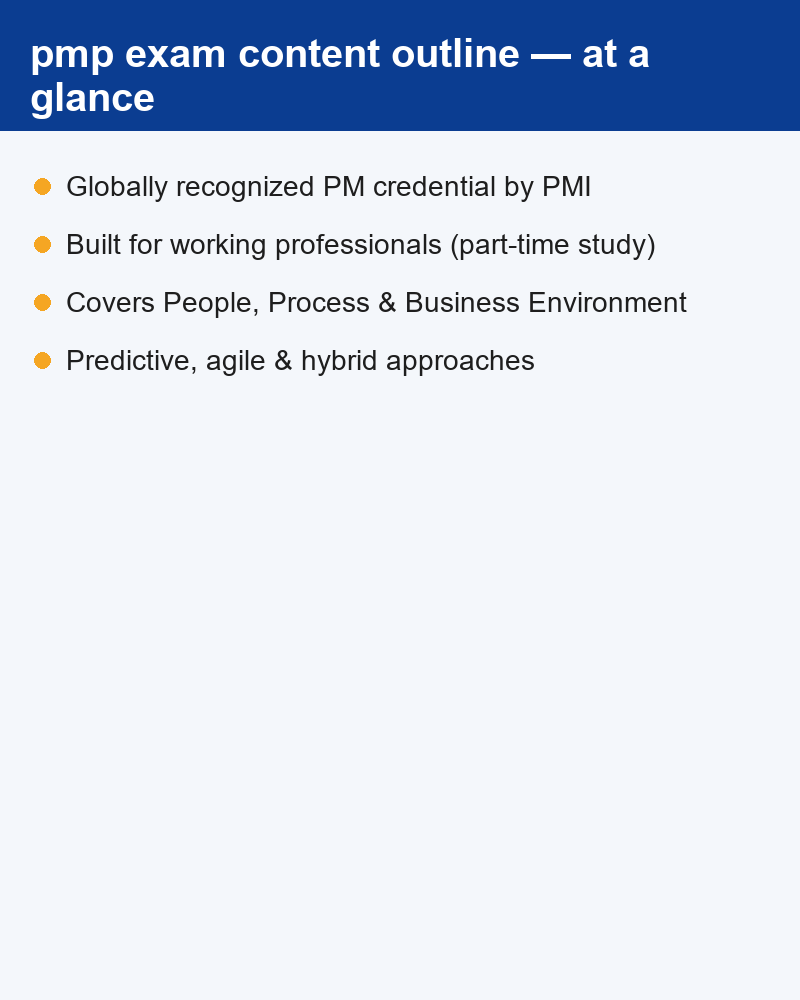
The current ECO organizes all project management work into three domains. People covers leadership and team skills. Process covers the technical mechanics of delivery. Business Environment covers compliance, value, and organizational change. Together they reflect how modern project leaders actually work across predictive, agile, and hybrid approaches. The split is People 42 percent, Process 50 percent, and Business Environment 8 percent of the weighted exam.
Notice that Process and People together are 92 percent of the exam. A working professional who masters those two domains while covering Business Environment lightly is already in strong shape. The weighting should directly drive your calendar, not your anxiety, because time is the scarcest resource when you study around a full-time job and family commitments.
People Domain — 42 Percent
The People domain is the largest at 42 percent. It tests how you manage conflict, lead a team, support virtual teams, mentor, and build collaborative stakeholder relationships. For working professionals this is the most intuitive section because it mirrors daily leadership. Study servant leadership, emotional intelligence, and team ground rules here. Expect questions about a teammate who is disengaged, a conflict that blocks a deliverable, or a sponsor who shifts priorities mid-sprint and expects you to absorb the churn without losing momentum.
Process Domain — 50 Percent
Process is 50 percent and the most technical. It covers scope, schedule, cost, quality, resource, communication, risk, procurement, and stakeholder integration. You must know how to plan and manage each across predictive and agile life cycles. Our process domain guide breaks this into study-ready chunks with examples drawn from IT, construction, and operations so the concepts stick instead of blurring together under exam pressure and time constraints.
Business Environment Domain — 8 Percent
Business Environment is 8 percent but easy points. It covers compliance, benefits realization, and managing external changes. Working professionals who have dealt with audits or regulatory shifts will recognize this immediately. Our business environment guide links the tasks to real organizational scenarios such as a new data-privacy law or a merger that reshapes governance and forces a replan of previously approved project scope and milestones.
Tasks and Enablers
Each domain contains numbered tasks such as 1.1, 2.7, or 3.2. Under each task sit enablers, the specific behaviors PMI expects. Exam questions are written against enablers, so map every practice question back to its task. This is how you turn passive reading into exam-ready recall and avoid the sinking feeling that you studied the wrong thing while a clock counts down on the real test.
Predictive, Agile, and Hybrid Coverage
The ECO deliberately blends methodologies. A single task can be tested as a waterfall scenario, a sprint scenario, or a hybrid mix. Your study plan must include all three lenses. Our agile and hybrid guide shows how one task appears across each approach so nothing on exam day feels foreign or forces you to guess between a predictive reflex and an agile mindset answer choice.
How the Outline Maps to the Exam
The 180-question exam draws from the weighted domains, but the ratio is approximate, not fixed per section. Expect scenario questions that cross domains. A risk scenario may also test stakeholder communication. The pmp exam content outline prepares you for this integration by emphasizing tasks over silos, which is exactly how projects behave in real life when a single decision ripples across cost, schedule, and team morale at once.
Study Plan Built on the ECO
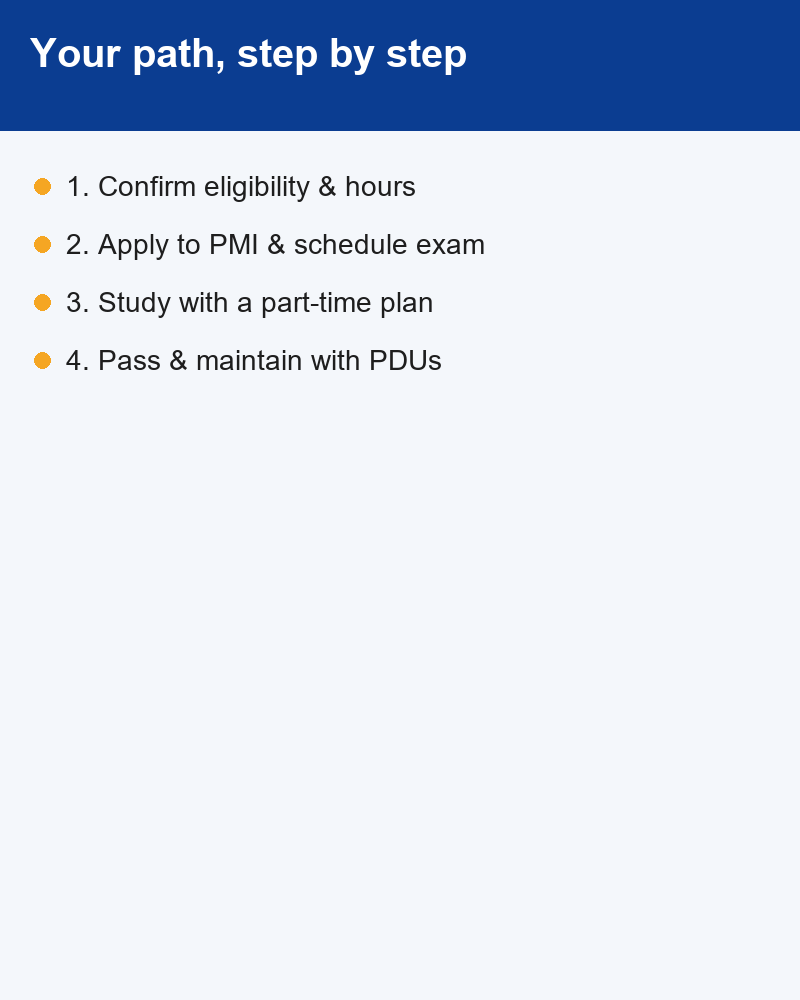
Spend your part-time weeks in proportion to weightings: roughly half on Process, two-fifths on People, and a focused slice on Business Environment. Use the enablers as a checklist. Our 12-week study plan shows the exact weekly split for working professionals who study eight to ten hours a week without burning out or falling behind on the day job that pays the bills and funds the exam.
Common Mistakes Working Professionals Make
The biggest error is over-studying process minutiae and neglecting People soft skills, which are 42 percent. The second is ignoring agile within predictive tasks. The third is memorizing enablers instead of applying them to scenarios. Avoid all three by practicing situational questions weekly and reviewing why each wrong answer was wrong so the lesson survives until test day and beyond.
ECO vs the Old Syllabus
Older PMP material focused on process groups and knowledge areas. The current pmp exam content outline replaced that with domain tasks and equal agile coverage. If your training is pre-2021, refresh it. Outdated syllabi quietly cost candidates points because the question style has changed even when the underlying fundamentals have not, and familiarity with old language creates confident wrong answers.
Free Resources to Anchor Your Study
PMI publishes the ECO as a free PDF. Pair it with a part-time study plan and a mock exam schedule. Our practice exam guide explains how to use the outline to grade your readiness before booking the real test, so you walk in confident rather than hopeful and protect the money and vacation time you invested in the attempt.
Frequently Asked Questions
Is the 2026 ECO different from 2021? The domain structure is stable; always download the latest PDF from PMI to catch minor enabler wording changes and confirm current weightings before you book your seat and commit to a test date with real consequences.
Do I need to memorize task numbers? No. Understand the behaviors. Questions test application, not numbering, so recognition of the right action matters more than recall of a label that no employer will ever ask you to recite in an interview or a standup meeting.
How do I know I am ready? When mock exams across all three domains score consistently above target, using the outline as your audit tool, you are ready to schedule the real exam and trust the preparation you built methodically on evenings and weekends.
Authoritative source: PMI — Official PMP Certification
Get a Free PMP Consultation
Working professional planning your PMP? Get a personalized part-time study plan.


