
The PMP exam changes introduced in July 2026 are the biggest update to the exam since 2021. If you plan to sit the exam in 2027, they decide what you should study, which question styles you should practise and how you should describe your experience in the application. This guide sets out what changed, what did not, and how to adapt, using PMI’s own July 2026 exam content outline. For the full path from application to exam day, see our PMP certification page.
Reviewed against PMI’s PMP Examination Content Outline (July 2026) on 16 November 2026. Details can change, so confirm them on the official PMP page.
Key takeaways
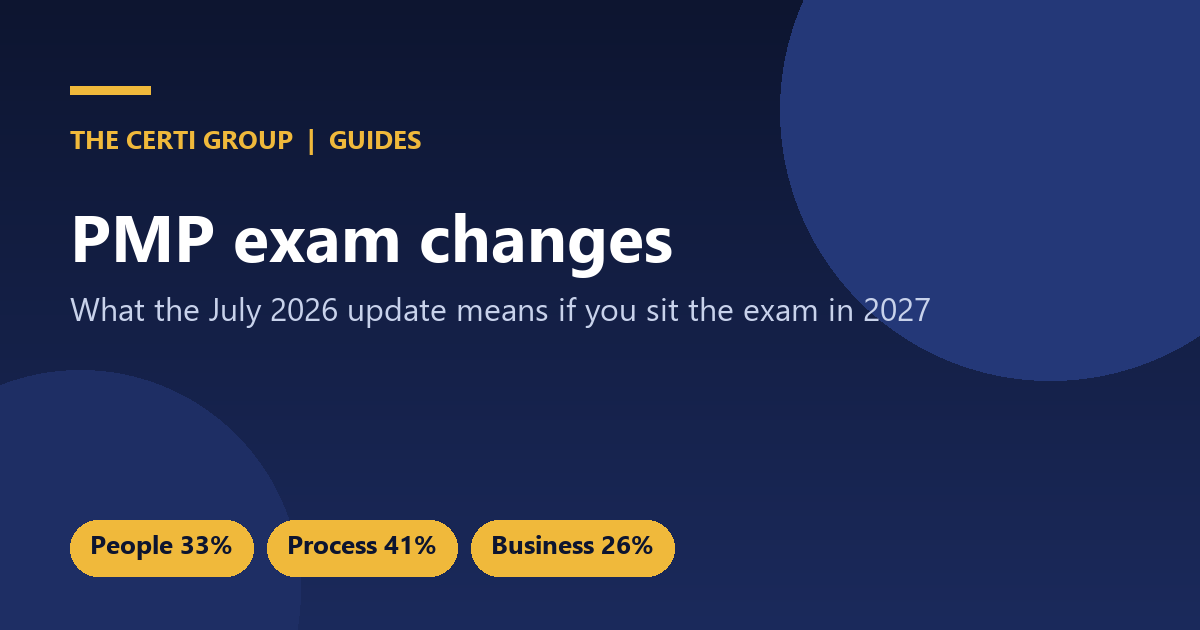
- The July 2026 outline weights the exam People 33%, Process 41% and Business Environment 26%. The old outline gave Business Environment only 8%.
- The exam is still 180 questions in 240 minutes, but it adds scenario-based and graphic-based question types.
- Experience must now fall within the 10 years before you apply, and PMI has added stricter verification of education and training.
- Artificial intelligence and sustainability were assessed as trends in the job analysis behind the update.
Table of contents
PMP exam changes at a glance
| Area | What PMI’s July 2026 outline says |
|---|---|
| Questions and time | 180 questions (170 scored, 10 unscored pretest) in 240 minutes, with two 10-minute breaks |
| Domains | People 33%, Process 41%, Business Environment 26% |
| Approaches | About 40% predictive, about 60% split between agile and hybrid, spread across all domains |
| Question types | Adds case or scenario questions and graphic-based questions, alongside multiple-choice, multiple-response and matching formats |
| Experience window | All experience must fall within the last 10 years before you apply |
| Trends reviewed | Artificial intelligence and sustainability were assessed in the job analysis behind the update |
PMP exam changes to the domains
The most important of the PMP exam changes is the weighting. The previous outline split the exam People 42%, Process 50% and Business Environment 8%. The July 2026 outline moves to People 33%, Process 41% and Business Environment 26%.
In practice this means more questions about strategy, value and benefits, governance and compliance, and organisational change. Candidates who are strong in schedule, cost and risk but have little exposure to business case thinking should plan extra time for Business Environment. The old rule of thumb, that most of the exam is about leading people and running the process, is no longer enough.
PMI also states that predictive, agile and hybrid approaches appear throughout all three domains and are not confined to one task. Plan to study all three ways of working rather than treating agile as a separate topic.
PMP exam changes to question types
Two question types are marked as new in PMI’s outline: case or scenario questions, where you read a detailed situation and answer a series of questions about it, and graphic-based questions, where you interpret charts, graphs or diagrams. Other formats remain: multiple-choice with one correct answer, multiple-response, matching, pull-down lists and point-and-click questions, with some formats available only at test centres.
Practice with realistic scenario sets. A single case with several questions rewards careful reading and consistent judgement, not memorised definitions. If you use practice exams, check that they were written after July 2026 and include scenario and graphic questions.
PMP exam changes to eligibility and verification
The outline lists four routes: 60 months of leading projects for secondary school education, 48 months for an associate-level or technical qualification, 36 months for a bachelor’s degree or higher, and 24 months for a degree from a PMI Global Accreditation Center programme. All of that experience must be within the past 10 years.
PMI also says it is introducing enhanced verification in the application system. If your qualification does not state its level in an international framework, you may need a statement from the awarding body or a national authority. Candidates should therefore keep certificates, training records and signed experience confirmations ready. We explain each route in our guide to PMP eligibility requirements.
PMP exam changes to the 35 hours of training
You still need 35 hours of project management training aligned to the outline, unless you hold an active CAPM. Books and practice exams alone do not count. PMI has also announced changes to how live classes are recognised, so check its current position before you book an instructor-led course.
How to adjust your PMP study plan for 2027
- Download the July 2026 outline and mark the tasks in each domain against your own experience.
- Rebalance your time. Give Business Environment more hours than the old plans did and keep People and Process in proportion.
- Study all three approaches. Work through predictive, agile and hybrid scenarios in every domain.
- Practise case and graphic questions in timed blocks, then review why each answer is the best choice.
- Take full-length timed mocks until your results are steady in all three domains, then book.
What has not changed
The exam is still 180 questions in 240 minutes. The credential is still maintained with 60 professional development units every three years. PMI still delivers the exam through Pearson VUE, at a test centre or online with a proctor, and you still have one year from approval to take it, with up to three attempts. If you are applying from the Gulf, read our guides to PMP certification in the UAE and PMP certification in Saudi Arabia.
Frequently asked questions
Do the PMP exam changes apply if I already started studying?
They apply to the exam you sit, not to when you started studying. If you are taking the exam in 2027, you are tested on the July 2026 outline, so make sure your study material matches it.
Is the 2021 PMP outline still valid?
No. PMI’s July 2026 outline replaces it, so material that follows the 2021 weightings underweights Business Environment.
Did the number of PMP exam questions change?
No. The exam still has 180 questions, 170 scored and 10 unscored, in 240 minutes.
Do the PMP exam changes affect people who are already PMP certified?
No. Existing PMP holders keep their certification by earning 60 PDUs every three years and paying PMI’s renewal fee.
Does the PMP exam include artificial intelligence?
PMI says artificial intelligence and sustainability were assessed as trends in the job task analysis behind the update. Check the outline’s task list for how they appear in each domain.