
The CFE application has five requirements, and ACFE lists them in a clear order: membership, points, experience, the exam and the code of ethics. This guide turns them into five essential steps, with the evidence to prepare and the mistakes to avoid. Our page on the CFE certification shows how we support candidates in the UAE and Saudi Arabia.
Reviewed against ACFE’s CFE credential, eligibility, exam and exam preparation pages on 21 November 2026. ACFE can change its rules, so confirm them on the official CFE eligibility page.
Key takeaways
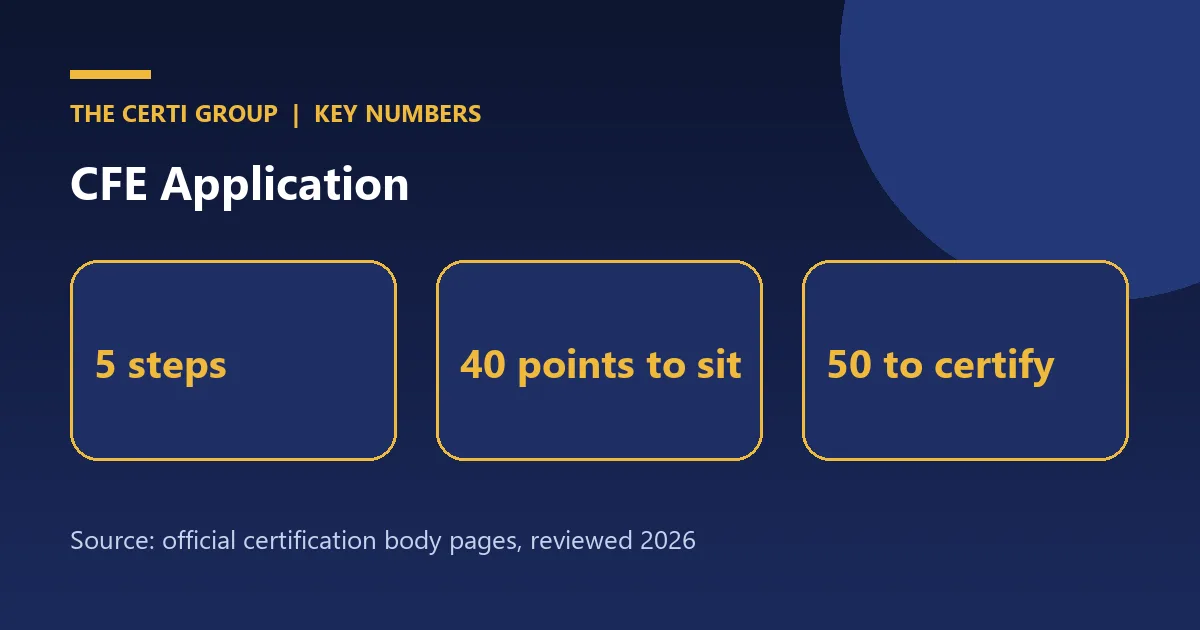
- You must be an Associate Member of the ACFE to take the exam and earn the credential.
- You need 40 points to take the exam and 50 points plus two years of experience to be certified.
- ACFE accepts eight categories of fraud-related experience, and your own may qualify even if not listed.
- You must agree to ACFE’s Code of Professional Ethics.
Table of contents
The five CFE requirements
| Requirement | What ACFE states |
|---|---|
| Membership | You must be an Associate Member |
| Points | At least 40 to take the exam and 50 to be certified |
| Experience | Two years in a field related to detecting or deterring fraud, by the time of certification |
| Exam | Pass the three-section CFE exam |
| Ethics | Agree to the Code of Professional Ethics |
CFE application: 5 essential steps
- Join ACFE as an Associate Member.
- Calculate your points with ACFE’s points calculator, using education and fraud-related work.
- Apply for the CFE exam and agree to the Code of Professional Ethics again.
- Activate your eligibility once you are approved, which starts the 60-day window. See CFE exam dates.
- Sit the exam, then provide your experience once you have 50 points and two years.
What counts as experience
ACFE’s Board of Regents has approved these categories: accounting and auditing; compliance and ethics; corporate security and loss prevention; fraud investigation; fraud prevention and fraud risk management; fraud-related legal services, litigation support and consulting; proactive fraud detection; and teaching, writing or researching on fraud-related topics. If your work is not on the list but your duties include preventing, detecting or investigating fraud, ACFE says it may still qualify.
Preparing your CFE application evidence
Keep your degree details, employers, dates and a plain description of the fraud-related tasks you performed. Describe the work, not just the job title, and link each task to one of ACFE’s categories. Having this ready makes the CFE application faster.
Common mistakes
- Applying without checking points first.
- Assuming that a job title alone is enough.
- Waiting to activate and then having too little time inside the 60 days.
- Forgetting that certification needs 50 points and two years of experience, even if you pass the exam earlier.
Where the CFE application fits
See CFE without a degree if you are working out your points, and CFE certification requirements for the full picture.
A worked example of a CFE application
A candidate in compliance has a bachelor’s degree, which earns 40 points, and three years of experience in accounting and auditing. They join ACFE, check their points with the calculator and apply for the exam. After approval they activate eligibility, book their three sections inside the window and pass. Because they already have 50 points and two years, ACFE can award the credential once the experience is confirmed. If they had waited to gather evidence until after the exam, certification would have been delayed.
How The Certi Group can help with cfe application
We support candidates in the UAE and Saudi Arabia with a points check against ACFE’s rules, a study plan, timed mock exams and booking guidance for the CFE. We do not run training or set the exam, and we do not promise a result. ACFE marks the exam. Our fee is confirmed in a written quote.
Frequently asked questions
How do I do the CFE application?
Join ACFE, check your points, apply for the exam, activate and sit it.
How many points do I need?
40 to take the exam and 50 to be certified.
Do I need experience to sit the exam?
No. You need it to be certified.
What experience counts?
Eight approved categories, and other fraud-related duties may qualify.
Do I need a degree?
No. You can use experience points. See our guide.