
CFE without a degree is possible. ACFE requires 40 points to sit the exam and 50 points plus two years of fraud-related experience to be certified, and without a bachelor’s degree two years of fraud-related experience can replace each year of academic study. This guide explains the points, ACFE’s own example and how to plan the years. Our page on the CFE certification shows how we support candidates in the UAE and Saudi Arabia.
Reviewed against ACFE’s CFE credential, eligibility, exam and exam preparation pages on 21 November 2026. ACFE can change its rules, so confirm them on the official CFE eligibility page.
Key takeaways
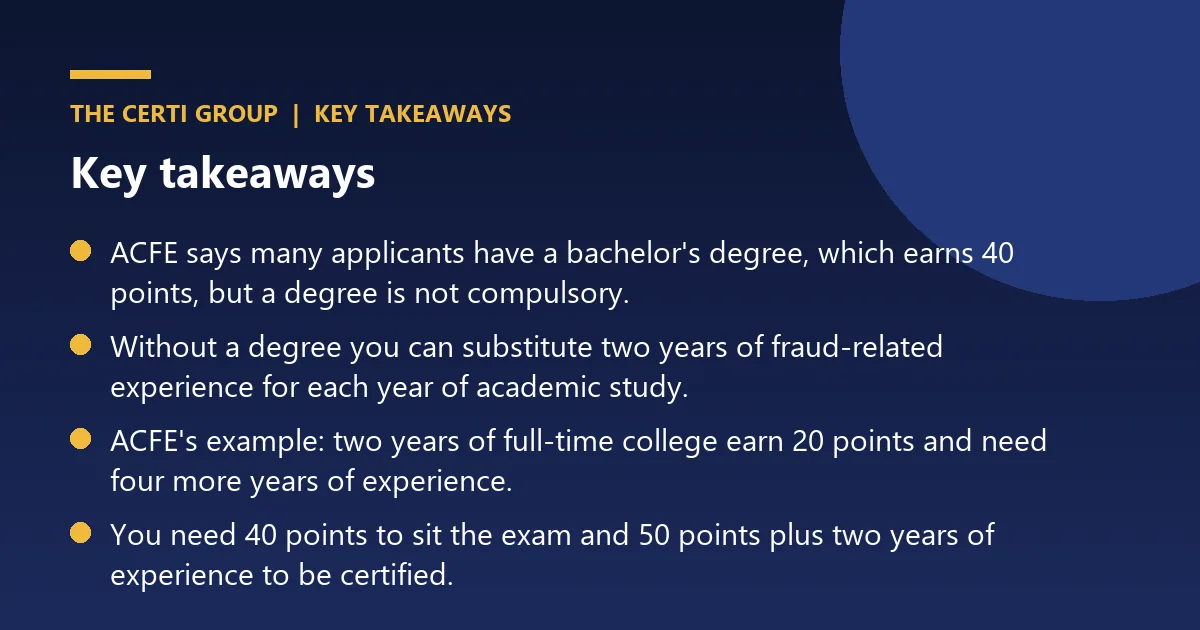
- ACFE says many applicants have a bachelor’s degree, which earns 40 points, but a degree is not compulsory.
- Without a degree you can substitute two years of fraud-related experience for each year of academic study.
- ACFE’s example: two years of full-time college earn 20 points and need four more years of experience.
- You need 40 points to sit the exam and 50 points plus two years of experience to be certified.
Table of contents
Do you need a degree to become a CFE?
ACFE’s eligibility page says many CFE applicants have a minimum of a bachelor’s degree or equivalent from an institution of higher learning, which earns 40 qualifying points, and that no specific field of study is required. It does not say a degree is compulsory. Education points must come from an accredited institution.
Can I get a CFE without a degree? The substitution rule
If you do not have a bachelor’s degree, you may substitute two years of fraud-related professional experience for each year of academic study. ACFE gives this example: if you attended college full-time for two years, you earn 20 points and still need an additional four years of professional experience to meet the education requirements.
How many points do you need for the CFE?
| Item | What ACFE states |
|---|---|
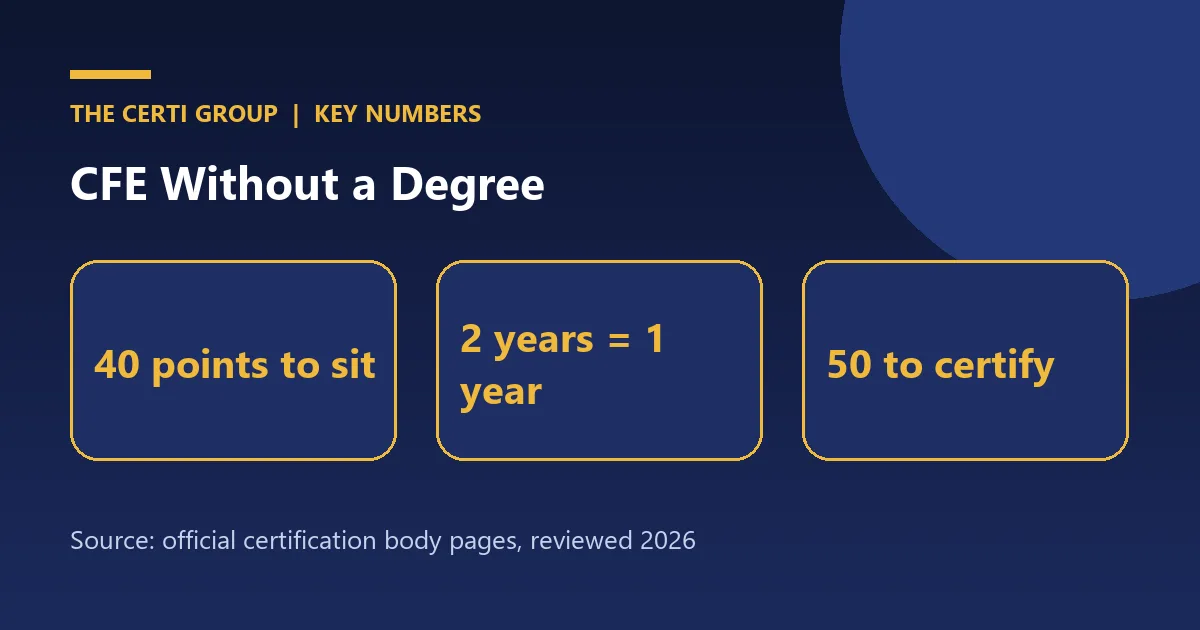
| Points to take the exam | 40 |
| Points to be certified | 50 |
| Experience to be certified | At least two years in a field related to fraud detection or deterrence |
See ACFE’s points calculator for your own numbers, and our guide to the CFE application for the steps.
How do you plan a CFE without a degree?
- List your years of education and the points they give.
- List your years of fraud-related experience and which of ACFE’s categories they fall under.
- Use the calculator to see the gap to 40 points.
- Decide whether to sit the exam once you reach 40 or wait.
- Aim for 50 points and two years of experience for certification.
Which experience counts toward a CFE without a degree?
ACFE’s Board of Regents has approved eight categories of fraud-related experience, listed on ACFE’s eligibility page:
- Accounting and auditing
- Compliance and ethics
- Corporate security and loss prevention
- Fraud investigation
- Fraud prevention and fraud risk management
- Fraud-related legal services, litigation support and consulting
- Proactive fraud detection
- Teaching, writing or researching on fraud-related topics
ACFE adds that if your work does not fall into one of these categories but your job responsibilities include the prevention, detection or investigation of fraud, your experience may still qualify. Describe your duties, not only your job title, when you apply.
What does a CFE without a degree look like in practice?
A candidate has no degree and eight years in internal audit. Using the substitution rule, they check how many years of study the experience can replace, then use the calculator to confirm their points. If they pass 40, they can sit the exam while they build the rest. We do not give a points figure, because only ACFE’s calculator gives an official answer.
What we could not verify
We did not test the calculator for each combination, and ACFE’s page says other certifications might contribute to points but do not automatically grant the CFE. Check the current rules and ask ACFE Member Services if your case is unusual.
What should you ask yourself before you apply?
Which of ACFE’s eight categories does my work fall under? How many years of fraud-related experience can I document? Do I have the dates, employers and duties written down? How far am I from 40 points, and how far from 50? Answering these before you apply gives you a realistic timeline, and it tells you whether to sit the exam now or build more experience first.
How The Certi Group can help with a CFE without a degree
We support candidates in the UAE and Saudi Arabia with a points check against ACFE’s rules, a study plan, timed mock exams and booking guidance for the CFE. We do not run training or set the exam, and we do not promise a result. ACFE marks the exam. Our fee is confirmed in a written quote.
Frequently asked questions
Can I get a CFE without a degree?
Yes. ACFE says many applicants have a bachelor’s degree, which earns 40 qualifying points, but if you do not have one you may substitute two years of fraud-related professional experience for each year of academic study. No specific field of study is required, and any education points must come from an accredited institution.
How many points do I need?
ACFE requires at least 40 points to take the CFE exam and at least 50 points to be certified. Points come from education and fraud-related work experience, and ACFE has a points calculator on its site to check your own total.
How does the substitution work?
Two years of fraud-related professional experience can replace each year of academic study. ACFE’s own example is a candidate with two years of full-time college, who earns 20 points and still needs four more years of professional experience to meet the education requirement.
Do I still need two years of experience?
Yes. To be certified you need at least two years of professional experience in a field related to the detection or deterrence of fraud, as well as 50 points. You can sit the exam with 40 points and less experience, but ACFE awards the credential only once you have both.
Where do I calculate my points?
ACFE has a points calculator on its CFE eligibility page. It uses your education and fraud-related work experience to show whether you meet the 40-point and 50-point thresholds, so check it with your own dates and ask ACFE Member Services if your case is unusual.