
CFE CPE requirements are simple to state and easy to neglect: ACFE asks every CFE to earn continuing professional education each year and to keep paying membership dues. This guide sets out the CFE CPE requirements, the two categories ACFE counts, a way to plan your credits and what we could not verify. Our page on the CFE certification shows how we support candidates in the UAE and Saudi Arabia.
Reviewed against ACFE’s CFE credential, eligibility, exam and exam preparation pages on 21 November 2026. ACFE can change its rules, so confirm them on the official CFE eligibility page.
Key takeaways
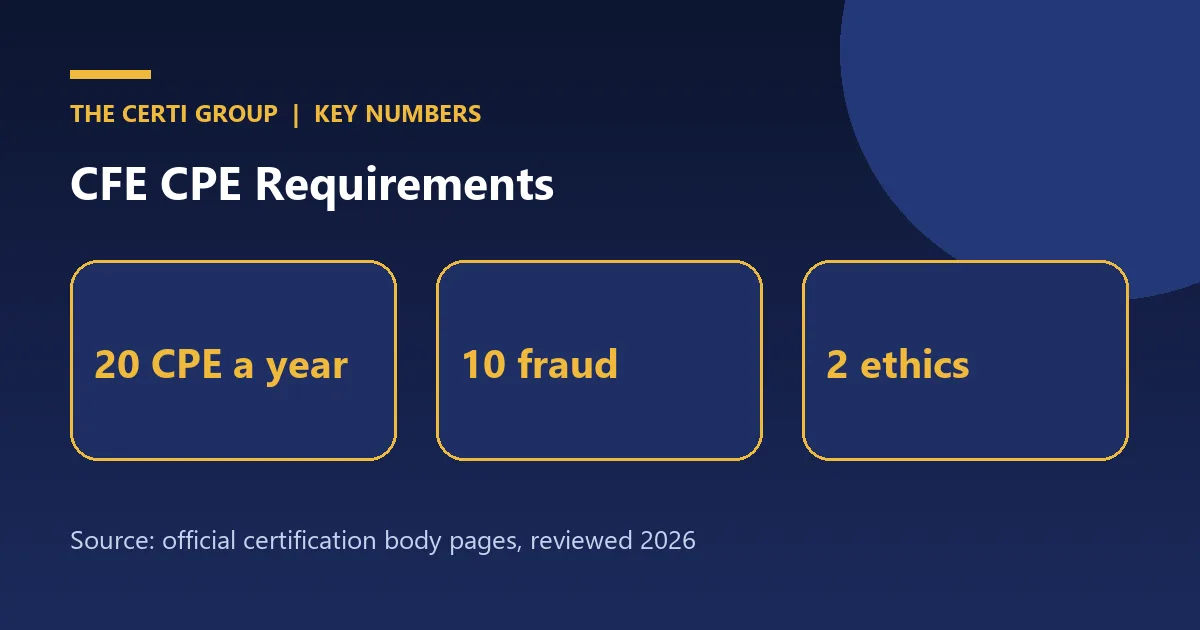
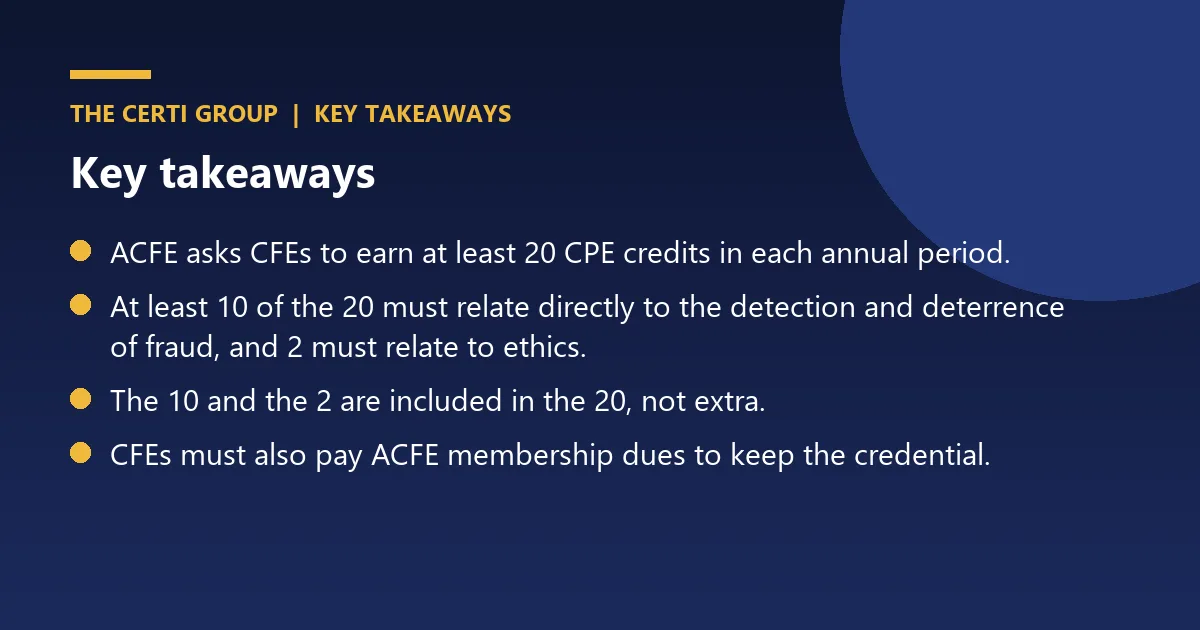
- ACFE asks CFEs to earn at least 20 CPE credits in each annual period.
- At least 10 of the 20 must relate directly to the detection and deterrence of fraud, and 2 must relate to ethics.
- The 10 and the 2 are included in the 20, not extra.
- CFEs must also pay ACFE membership dues to keep the credential.
Table of contents
The CFE CPE requirements at a glance
| Item | What ACFE states |
|---|---|
| Annual CPE credits | At least 20 in each annual period |
| Fraud detection and deterrence | At least 10 of the 20 |
| Ethics | At least 2 of the 20 |
| Membership | Dues must be paid to keep the credential |
The 10 fraud credits and the 2 ethics credits are part of the 20, not additional to them. So a CFE who earns 20 well-chosen credits can meet all three rules at once. See our guide to CFE certification requirements and the exam for the route to certification.
What counts toward your CFE CPE requirements
ACFE’s CPE rules cover training, events and other learning, and ACFE courses and events earn CPE. ACFE’s own point is that courses and events earn CPE but do not add eligibility points, so keep the two ideas separate. Check ACFE’s CPE page for the activities it accepts, because we did not verify every category, and the rules can change.
A simple plan for 20 credits a year
- Split the year into quarters and aim for five credits in each.
- Make sure at least two quarters include a fraud-focused activity, such as a course on schemes or investigations.
- Add a short ethics course early in the year, so the 2 ethics credits are done.
- Log each activity the week you finish it.
- Check your total each quarter against the annual target.
Records to keep
Save the certificate or proof of attendance, the date, the provider, the number of credits and a note of the category, whether fraud detection and deterrence, ethics or general. Keep them in one folder. If ACFE asks for evidence, you can answer quickly.
A worked example
A CFE in compliance attends a two-day fraud conference in spring, completes an ethics module in summer and reads and reports on a fraud case study in autumn. By December they have logged 20 credits, with 12 on fraud and 2 on ethics. They pass all three rules with room to spare. Another CFE leaves it to December and has to rush. Planning is the difference.
What we could not verify
- The exact deadline for reporting credits in each period.
- ACFE’s treatment of a missed period, a late payment or a lapsed membership. ACFE says its recertification rules cover lapsed members, but we did not read every detail.
- Whether any credits can carry over.
Read ACFE’s CPE page and ask Member Services before you rely on any grace period.
Related questions
If you want to know what happens if you stop, see does CFE certification expire. To decide whether the upkeep is worth it, see is the CFE worth it.
Questions to ask before you choose an activity
Before you spend time or money on a course, ask three questions. Does it relate to fraud detection and deterrence, so it can count toward the 10 credits? Is it an ethics course, so it covers the 2 ethics credits? Will you receive proof of attendance with the date and the number of credits? A short check before you register saves you from earning credits that do not fit the categories ACFE asks for.
How The Certi Group can help with cfe cpe requirements
We support candidates in the UAE and Saudi Arabia with a points check against ACFE’s rules, a study plan, timed mock exams and booking guidance for the CFE. We do not run training or set the exam, and we do not promise a result. ACFE marks the exam. Our fee is confirmed in a written quote.
Frequently asked questions
What are the CFE CPE requirements?
At least 20 credits each annual period, with 10 on fraud detection and deterrence and 2 on ethics.
Are the 10 and 2 credits extra?
No. They are included in the 20.
Do I pay dues as well?
Yes. ACFE requires membership dues to keep the credential.
Do ACFE courses count?
ACFE says its courses and events earn CPE.
Where do I check the rules?
On ACFE’s CPE and recertification pages.